Showing posts with label living abroad. Show all posts
Friday, January 29, 2016
Tuesday, December 22, 2015
Ask Me to Share
Has the past year been a dream? As I now sit comfortably at home in Ohio, my experience in South America seems surreal.
Memories flash before my mind, eliciting a smile or a tear and confirming that this was a real experience, a year in Colombia.
I recall the fresh fruits, happy giggles, blazing sun, broken Spanish, bumpy bus rides, and the list goes on...
Ask me to share about my time teaching and traveling on the Caribbean coast. Some stories are heartwarming, while others are scary. Even still, more are funny, adventurous, and joyous. Some stories are almost unbelievable without understanding of the cultural context, but I will do my best to accurately convey the reality of this wildly beautiful experience.
Now, all I can express is gratitude. "Muchas gracias" to strangers, students, fellow volunteers, family, and friends who supported me on this journey if only for a moment. Because of you, my year in Colombia was a priceless opportunity.
Here's to the next adventure.
Tuesday, November 24, 2015
Musings from a Pizzería
On a breezy Monday night in Barranquilla, some were walking their dogs. Others were taking a trip to the tienda to buy beans and rice for the next day's meal. Others still were catching a bus home from work, stuck in the maze of traffic that so often plagues the streets during the evening. I, however, sat in a pizzería, sipping a maracuya juice and fighting the tears that were forming in my eyes.
Less than three weeks remain until I return to the States.
Saying goodbye to the life that I've built over the past year is overwhelming. While being a challenge at many times, I am in awe of the overall beauty of this experience. With each obstacle overcome, I gained a new and profound fondness for the many many unique parts of this culture that have become the norm for my life. Here, underneath the squelching Caribbean sun, I unveiled a strength and grace of which I never knew.
I think of where I started. I think of where I ended. Every person that crossed my path this year was placed at the moment in my life for a reason. My student Ashley who so sweetly embraced my arrival to school, presenting me with a seashell and invitation to dinner. The quirky personalities that I met on the bike route who helped me integrate into the community. The strangers from all over the world who offered me friendship and assistance if only for a minute.
As I sat in the pizzería with the gentle buzz of the Spanish language surrounding me, I attempted to control the overpowering nostalgia that suddenly captured my heart. Without a doubt, I stand in eager anticipation of life's next adventure; but, I struggle with parting from the vibrant color that Barranquilla has added to my life.
Recently, I recalled a passage that I memorized in my high-school Spanish class. I am certain that I memorized these 16 words exactly so that I could reflect on them in this moment of my life six years later. Mateo 6:27: "¿Y quién de ustedes podrá, por mucho que se afane, añadir a su estatura un codo?"
Simply, this means, "Don't worry." With the bittersweet departure from
Barranquilla that approaches, I can find peace in the unknown and appreciate the beauty and growth of what evolved to be an incredibly short year in Colombia.
Thursday, October 22, 2015
Variety is the Spice of Life
Two-hundred and ninety-five days I have lived in Colombia. Many of these days have been spent in the classroom, while others are spent traveling cheaply along the coast or exploring the hidden gems of Barranquilla. To think that only eight days in the classroom remain in unbelievable.
Each day is a unique adventure, filled with unexpected twists and turns; therefore, describing a typical day is nearly impossible, but most days until recently usually followed a pattern that looked something like this:
The night before class:
9:00 p.m.: In order to prepare for the following day, I set aside $3,400 pesos for the bus ride to school and $2,000 pesos for my breakfast of two bananas and a package of nuts. That's just under the equivalent of $2 USD. I fill my water bottle, pack my bag, and decide what to wear for the following day. With the excessive heat and exhaustion of speaking a second language, I sleep at least eight hours a night. Before falling asleep, I make sure to lightly spray my sheets with bug repellent so that the mosquitoes don't bite me during the night!
The day of class:
6:05 a.m.: Off sounds my alarm! After washing my face, I usually dress in a pair of breezy pants and a tank top. I braid my hair or wrap it in a bun secured with a banana clip...a very popular fashion trend on the coast.
6:30 a.m.: Time to catch the bus. Even before 7 o'clock, I'm already sweating as I walk several blocks to the street where my bus passes. Some days I wait five minutes for the bus. Other days, I wait for 20 minutes. There are no bus stops; rather, when you see your bus approaching, you wave your hand in the street as signal for it to stop. The mornings are relatively quiet in Barranquilla, although many men along the street are already selling "tinto" (a small plastic cup of strong, bitter coffee) and "arepas de huevo" (eggs fried inside of a corn crust).
7:00 a.m.: Once I get off my bus, I walk into a "tienda" (a small store filled with a plethora of groceries and household items) to buy breakfast. As I walk several blocks to my school, I eat my bananas and wave to the students that I see en route to school with their parents. While some students walk, others ride on the back of a motorcycle. As I enter school, I greet the "portera" (the guard who stands at the entrance of the gated school) and make my way to my first class.
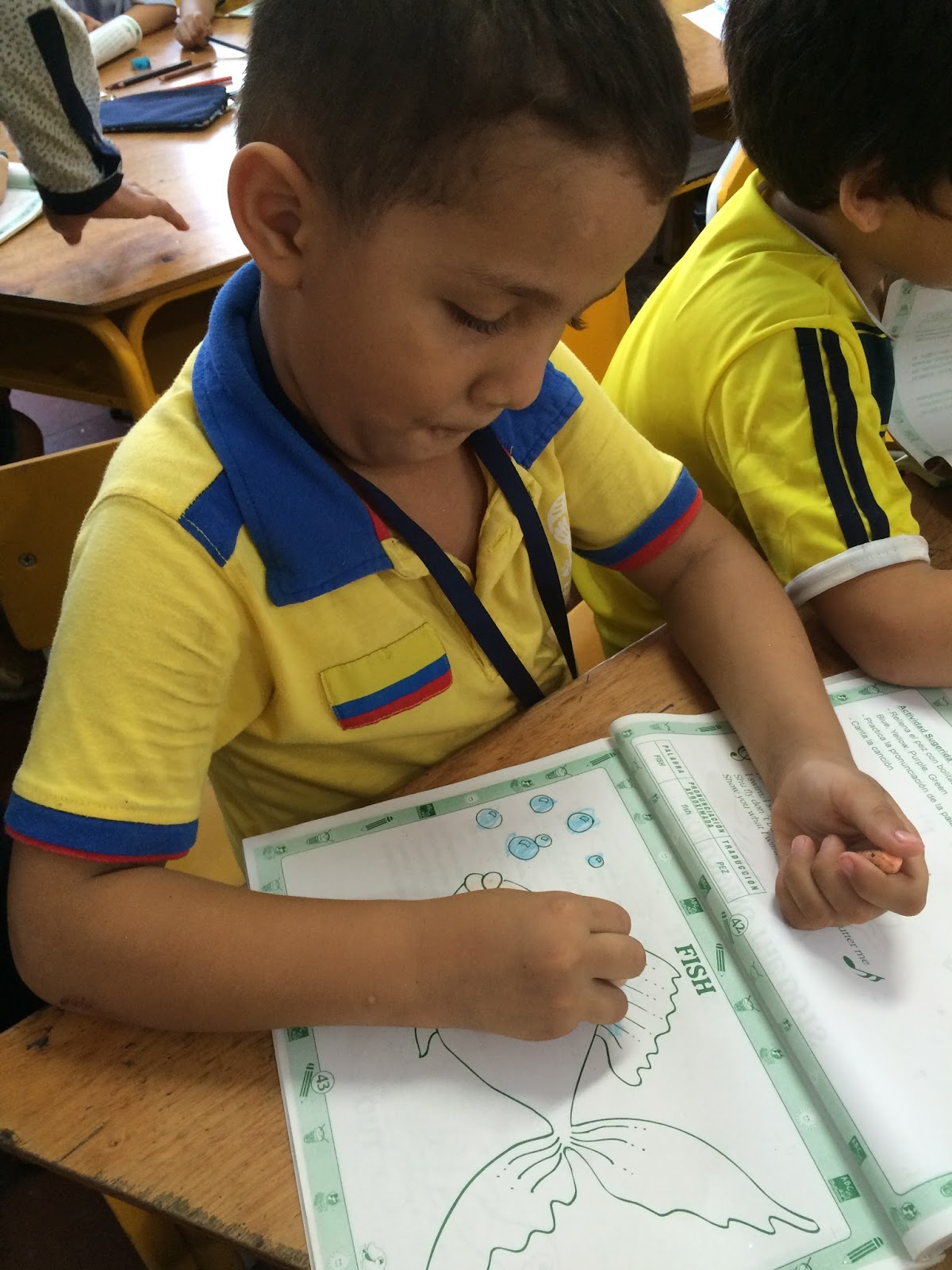
7:15 a.m.: Although class starts at 7 o'clock, students continue to arrive at school up to 30 or 40 minutes late. I begin class with songs...a favorite activity among Colombian students. Classroom activities also include chants with hand motions and completing activities in a textbook. Most rooms have air conditioning, which helps combat the heat.
10:00 a.m.: Descansa! During a brief recess period, students play soccer in an outdoor area in the center of the school. These resourceful students use an empty soda bottle when a soccer ball is unavailable. Others munch on chips and cookies from a small snack stand inside of the school. Being able to converse with my students during recess is my favorite part of the day. We often play hand games, like "thumb wars" or "rock, paper, scissors." The second-grade girls also love taking selfies on my cell phone.
10:30 a.m.: Back to class! During the last hour and a half of school, students are usually restless after recess, but we continue with our normal routine, sometimes consisting of group work or a dreaded exam.
12:00 p.m.: School's out! As I catch the bus home, salesmen jump aboard, selling everything from candy to coloring books. Sometimes a man representing a political party jumps onto the bus to distribute pamphlets about the upcoming election, while others will sing a salsa song or share a brief message about Catholicism. Ultimately, they are all looking for spare change in exchange for what they offer. The ride home from school in the afternoon is always much livelier than the ride to school.
1:00 p.m.: At lunchtime, I love cooking with eggs, quinoa, oats, lentils, and fresh fruits and vegetables. I usually go to a tienda once a week, spending about $20,000 pesos (or around $7 USD) on my supplies. I make sure to drink an overabundance of water and usually talk to my host family about the day while watching a soccer game.
2:00 p.m.: After eating is a perfect time to take a nap or call my mom! Being able to stay connected to my family is incredibly important and I am thankful for the strength that their support provides.
3:00 - 9:00 p.m.: The afternoons and evenings are spent completing paperwork for my Teaching English as a Second Language (TEFL) certification, attending a small Spanish class, meeting friends for dinner, reading, or seeing a movie. On Wednesdays, a ticket to the movie theater costs $2 USD! Obviously, planning for my next lesson is an essential afternoon routine!
Why are no two days alike in Barranquilla? Many factors contribute to the unpredictably of a day on the coast. During the powerful, heavy rainstorms of September and October, deadly rushing water races through the streets and halts all activity. Furthermore, an outage of water or electricity can delay the start of a day. "Puentes" (three-day weekends) occur frequently as Colombians celebrate a national holiday. Even a national soccer game can cut a workday short as Colombians prepare to watch the game.
If variety is the spice of life, then Barranquilla is the place to be.
Sunday, October 11, 2015
Seven Lessons from Barranquilla
Living in a new place for a year is an invigorating and intimidating experience, each day providing a plethora of learning opportunities. As I reflect on the past ten months, I am overwhelmed by what Barranquilla has taught me as I begin to transition into the next stage of my journey:
1. Be thankful and express gratitude. I am indebted to my family for the constant love that they showcase to me. In countless ways, the give me the strength to tackle any task...whether it's in the classroom or kitchen. Calling my mom multiple times a day is not uncommon, asking her questions about everything from job applications to cooking beans. I am incredibly thankful for and humbled by the emotional (and financial, at times) support that they provide, as it enables me to perform my duties in Barranquilla to my highest level. Thank you!
2. Seize tasks with selectivity. In other words, learn to say no. Colombians are very persuasive in their techniques when asking for a favor; however, in being selective in that tasks that I undertake, I am able to dedicate my energy to that which is most pertinent and where my skills can be best utilized. Furthermore, self-control, the discretion to determine whether something is absolutely necessary, is something that I have also developed during my time in Barranquilla. For example, shaved ice with a sugary topping is (sadly) not essential on a daily basis, from both a health and financial perspective.
3. Treat yo'self. In contrast, celebrating victories (both big and small) is an important part of life abroad. Having goals to achieve and small rewards for my accomplishments inspires me to stay invested into my personal and professional aspirations. After a rigorous month of teaching, I spent $22 on a simple hotel room where I could spend the night in air-conditioning and watch television in English. The fact that a treat like this is so rare makes it so much more enjoyable as I celebrate achievements.
4. Explore on your own. Sometimes the most peaceful, beautiful moments of self-reflection and self-growth are those that are spent solo. Taking a moment to be independent in the strong, community-orientated culture of Colombia is rejuvenating. To venture to the beach for a day or tour a museum alone builds confidence and creativity as I inadvertently stumble upon minor hiccups along the way.
5. Don't think about it too hard! Investing my energy into over-analyzing circumstances outside of my control is draining. Sometimes the line at the supermarket is long and slow. Sometimes I find worms in the tomatoes that I am cutting up for lunch. Sometimes strange, unfamiliar men on the street make comments about my "blonde" hair and pale skin. In these situations, I can only control my reaction and move forward positively.
6. Be content without closure. Knowing the long-term outcome of my time in the classroom is impossible. Will my student be the future mayor of Barranquilla? Will my student be a successful adult of character and integrity? Am I making a difference? Revel in uncertainty. Embrace the mystery. I may never understand why a student clings to my arm all day, but I know that I am offering that student the stability that she needs in that moment. Everything happens for a reason.
7. Share in each others' joy and sorrow. Latin Americans make no hesitation in expressing their feelings. Although I cannot always understand what I being said, I can recognize non-verbal cues and match these expressions. If a child is crying at school, I hug them and sympathize with them. If a co-teacher offers a smile or laugh, I can do that same. Connecting to the emotions of others is vital!
Thank you, Barranquilla, for a challenging, rewarding past ten months. I can only imagine what the final two months hold.
Tuesday, May 26, 2015
I Spy.
Within the past six years, I have had the opportunity to travel, study, or serve within 5 countries: Costa Rica, Belize, Nicaragua, Peru, and Colombia.
When I first traveled to Costa Rica in 2010, my surroundings left me in awe. Me senses were alive to each detail of the adventure. I remember the bumpy bus rides over miles of unpaved rocky roads where houses stood tucked within the hills. I remember the taste of the exotic fruits we tried alongside the road. I remember the barefoot children laughing, playing, and chattering to me in a language foreign to my ears. I remember the embraces of people I had just met, yet who were still so connected to my soul.
With each time I am abroad, I become more acclimated to the culture around me. I will always appreciate the vibrance of being in Latin America; however, I sometimes forget the richness of these experiences as the novelty of a new environment fades.
In an effort to be more conscientious of my Latin-American surroundings, I crafted a list of 15 charming (and occasionally alarming) sights within my neighborhood in Barranquilla.
1. Every morning, numerous men walk through the streets balancing giant bowls of ripe avocados on their heads and declare, "Agua, aguacate!" I usually buy a small one for around $1 USD. Sometimes I eat it with rice and beans. Other times I eat it in a salad of cilantro, tomato, onion, and vinegar.
2. Seeing juicy orange mangos crushed in the street is not uncommon. They fall from the trees onto the sidewalks and streets. Sometimes they are gathered to eat or sell, while other times they are left to the mercy of the busses and cars that pass through the streets.
3. Donkey-drawn carts are pulled through the streets, often carrying produce, construction supplies, or trash. I have seen small boys racing these donkeys and their carts down the street as fast as they could go.
4. Massive speaker systems don many front porches as the tunes of famous salsa, vallenato and champeta music plays. Plastic chairs are scattered across gated lawns where families gather to listen to music and talk, especially on the weekends or special occasions. Music can usually always be heard from the small "tienda" stores or cars driving through the streets.
5. Every child from preschool to secondary is required to wear a uniform to school. The styles of uniforms are vast. Most notably, some are denim, while others are burgundy and yellow plaid. Donning their school uniforms, these children often spend time at the mall after school eating ice cream or in the park playing soccer. I once saw a toddler who was wearing a pink gingham jumper. The sight of her clutching her father's hand and joyfully singing a song melted my heart.
6. Colombia is a colorful country...even the busses maneuvering through the streets showcase a rainbow of color. One bus, painted in swirls of red, yellow, green, and blue, drives toward the beaches of Pradomar. Inside of the buses are fringed curtains and sometimes vivid illustrations of famous cartoon characters like Bugs Bunny.
7. In the cool evenings, barefoot children play soccer in the less-trafficked side streets. They boisterously cheer upon scoring a goal, and are quick to pause their game at the sight of a car. Even the youngest of players adeptly steers the ball around boys of the opposing team.
8. Outside of a corner tienda at all hours of the day, a large group of men play dominos. Their laughter roars, but their faces quickly turn serious in the deep competition of the game. They also play chess or card games with intense concentration.
9. Litter is scattered across many sidewalks and streets. I imagine how much more beautiful Barranquilla would be without the pieces of plastic and paper cluttering the sidewalks.
10. With "blonde" hair and fair skin, I am especially prone to receive attention from men on the streets. Being called a princess, a doll, beautiful, or divine is a daily occurrence. Understanding that Colombia is a very vocal, expressive country helps provide context to these comments; however, even after five months, I still have not have not adjusted to hearing these harmless (yet annoying) noises.
11. Moto taxis are a cheap, exhilarating, and sometimes dangerous mode of transportation. Motorcyclists guarantee a helmet and a fast ride to anyone who hails them off the street. A multitude of moto taxis are always on the streets.
12. To fall victim to or witness a robbery is sadly not uncommon. Taking special precautions is essential. I never carry a purse or wear jewelry. I also walk with purpose to my destinations. Because I do not like to take technology outside of my house, I do not have many photos; but, I ultimately prefer to protect my belongings and myself.
13. Laundry air drys outside the brightly-painted cinder-block homes, blowing in the cherished breezes. The heat of the Caribbean sun quickly drys the clothes. Costeños, or those living on the coast, usually wear vivid colors and bold patterns. Women usually always wear high-heeled wedges.
14. Vendors sell a plethora of items on the streets outside of bigger grocery store. DVDs and CDs in thin plastic sleeves are less than $1 USD. I occasionally see a man sitting on sidewalks with an array of padlocks, while others sell nail files, or brooms.
15. Within my neighborhood close to Parque Olaya, tree trunks and electric poles are often painted with thick red, yellow, and blue stripes at the bottom. Colombian pride is in abundance. These colors make even a cloudy day a little more cheerful.
These are just 15 observations of my Colombian home. So many more people and places make Barranquilla a charmingly bold place to live.
Labels:
Barranquilla,
Colombia,
culture,
living abroad,
service,
travel
Subscribe to:
Posts (Atom)